
If German grammar has ever made you want to close the book, modal verbs are one topic that actually works in your favour. They’re the small words that let you say what you can do, must do, want to do, or are allowed to do. Master these six little verbs and your German instantly sounds more natural, polite, and confident.
What Are Modal Verbs in German?
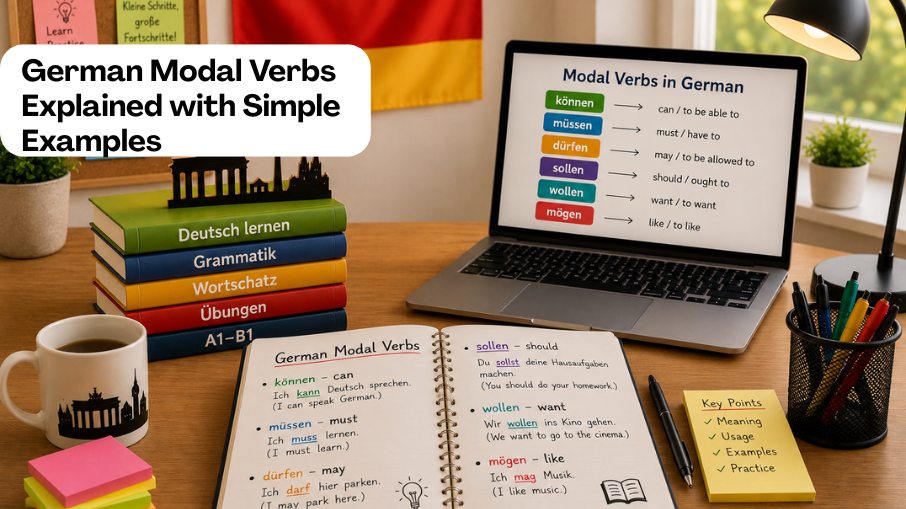
German modal verbs are helper verbs that change the meaning of the main verb in a sentence. They express ability, permission, obligation, desire, or necessity. Instead of saying “I go,” you can say “I want to go,” “I must go,” or “I can go,” and that’s the job modal verbs do.
There are six modal verbs in German: können, müssen, dürfen, sollen, wollen, and mögen. Learn these and you unlock a huge range of everyday expression.
How Do German Modal Verbs Work in a Sentence?
The rule is simple and consistent: the modal verb is conjugated and sits in the second position, while the main verb stays in its basic infinitive form and moves to the very end of the sentence.
For example: Ich kann Deutsch sprechen. (I can speak German.) Here “kann” is conjugated and second, while “sprechen” stays unchanged and jumps to the end. Once this pattern clicks, every modal verb sentence follows it.
The Six German Modal Verbs Explained
Let’s look at each modal verb, what it means, and how to use it with easy examples.
1. können (can, to be able to)
Used for ability or possibility.
- Ich kann schwimmen. (I can swim.)
- Kannst du mir helfen? (Can you help me?)
2. müssen (must, to have to)
Used for necessity or strong obligation.
- Ich muss jetzt gehen. (I must go now.)
- Wir müssen viel lernen. (We have to study a lot.)
3. dürfen (may, to be allowed to)
Used for permission.
- Darf ich hier sitzen? (May I sit here?)
- Kinder dürfen nicht rauchen. (Children are not allowed to smoke.)
4. sollen (should, ought to)
Used for advice, expectation, or an instruction from someone else.
- Du sollst mehr Wasser trinken. (You should drink more water.)
- Ich soll den Arzt anrufen. (I’m supposed to call the doctor.)
5. wollen (to want to)
Used for wishes and intentions.
- Ich will Deutsch lernen. (I want to learn German.)
- Sie will nach Berlin reisen. (She wants to travel to Berlin.)
6. mögen (to like)
Used to express liking. Its polite form “möchten” means “would like.”
- Ich mag Kaffee. (I like coffee.)
- Ich möchte einen Tee, bitte. (I would like a tea, please.)
Conjugation of German Modal Verbs (Present Tense)
Modal verbs are irregular, so the vowel often changes in the singular forms. Here’s how they conjugate with “ich,” “du,” and “er/sie/es”:
- können: ich kann, du kannst, er kann
- müssen: ich muss, du musst, er muss
- dürfen: ich darf, du darfst, er darf
- sollen: ich soll, du sollst, er soll
- wollen: ich will, du willst, er will
- mögen: ich mag, du magst, er mag
Notice that “ich” and “er/sie/es” always share the same form. That small pattern saves you a lot of memorising.
Common Mistakes to Avoid
A few slips trip up almost every beginner. Watch for these:
- Conjugating the second verb: The main verb must stay in the infinitive. Say Ich kann kommen, not “Ich kann komme.”
- Wrong word order: The main verb goes to the end. It’s Ich muss heute arbeiten, not “Ich muss arbeiten heute.”
- Mixing up “wollen” and “möchten”: “Ich will” is direct and strong, while “Ich möchte” is polite. In shops and restaurants, “möchte” sounds much better.
Why Learning Modal Verbs Matters
Modal verbs show up in nearly every real conversation, from asking permission to making plans to being polite. Once you’re comfortable with them, you can express needs, wishes, and abilities clearly, which makes everyday German feel far less intimidating. They’re a small group of words with a big payoff.
Master German Grammar with ASAP German Language Institute
Understanding German modal verbs is an important step toward speaking German naturally and confidently. While words like können, müssen, dürfen, sollen, wollen, and möchten may seem challenging at first, learning them becomes simple with the right guidance and regular practice. At ASAP German Language Institute, our experienced trainers explain German grammar using easy-to-understand examples, interactive lessons, and real-life conversations, helping you build a strong foundation from the very beginning.
Ready to improve your German grammar and communication skills? Enroll today or learn more about our German language courses by visiting our website or calling us at +91-9209203333. Our expert trainers are here to support you at every stage of your German learning journey.
Stay connected with us for German grammar tips, vocabulary lessons, course updates, and language-learning resources:
- Facebook: https://www.facebook.com/asapgerman
- Instagram: https://www.instagram.com/asap_german.com_
- Website: https://www.asapgerman.com/
Have questions about German grammar, modal verbs, course levels, or admissions? Send us a WhatsApp message, and our expert counselors will be happy to guide you and help you choose the right German course.
Frequently Asked Questions
1.How many modal verbs are there in German?
There are six modal verbs in German: können, müssen, dürfen, sollen, wollen, and mögen. Each expresses something different, like ability, necessity, permission, or desire.
2.Where does the main verb go in a modal verb sentence?
The main verb stays in its infinitive form and moves to the end of the sentence, while the conjugated modal verb sits in the second position.
3.What is the difference between “wollen” and “möchten”?
“Wollen” means “to want” and sounds direct. “Möchten” means “would like” and is more polite, so it’s the better choice in shops, restaurants, and formal situations.
4.Are German modal verbs irregular?
Yes. Most modal verbs change their vowel in the singular forms, and the “ich” and “er/sie/es” forms are always the same. Learning the pattern makes them easy to remember.