
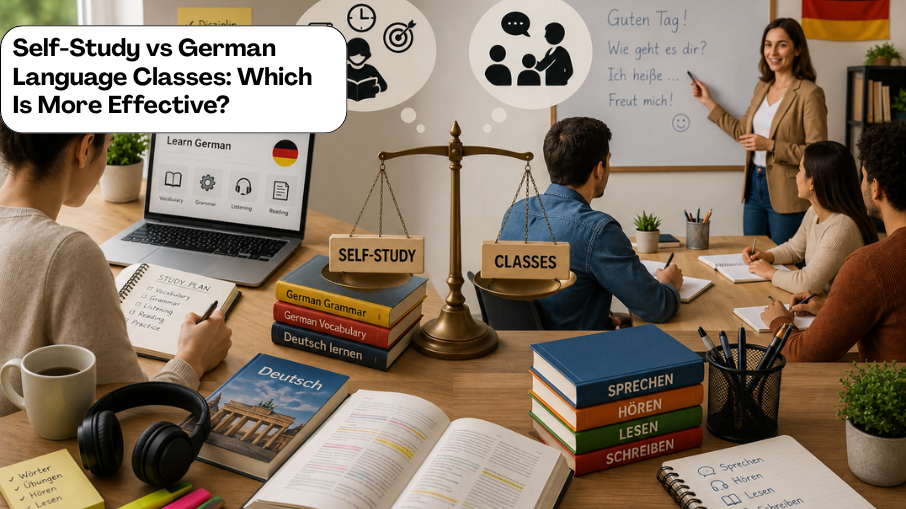
Self-study or German language classes, which actually gets you speaking German faster? Compare cost, structure, motivation, and results to pick the right path for your goals.

German A1 Course Syllabus: What Will You Learn?
A clear, beginner-friendly guide to the German A1 course syllabus, the skills you’ll build, the benefits of finishing A1, and who should enroll. Includes FAQs on duration, eligibility, and certification.

Top Jobs for German Language Experts in India
Confused about German language levels? Here’s a complete breakdown of A1, A2, B1, B2, and C1 — what you’ll learn, how long each takes, and which level you need for study, work, or visa purposes.
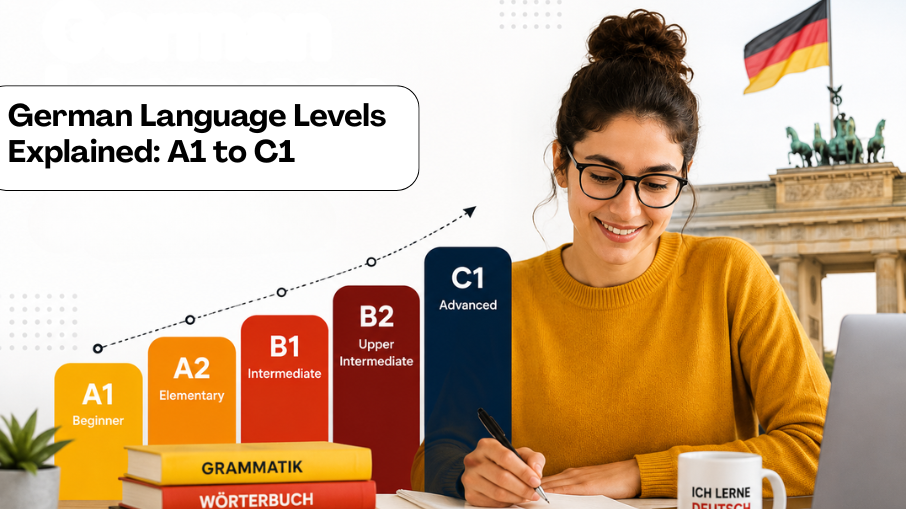
German Language Levels Explained: A1 to C1
Confused about German language levels? Here’s a complete breakdown of A1, A2, B1, B2, and C1 — what you’ll learn, how long each takes, and which level you need for study, work, or visa purposes.

Goethe A2 Exam Preparation: Complete Guide for Beginners
Preparing for the Goethe A2 exam? Get a complete guide covering exam pattern, syllabus, key skills, and preparation tips to help you pass with confidence.
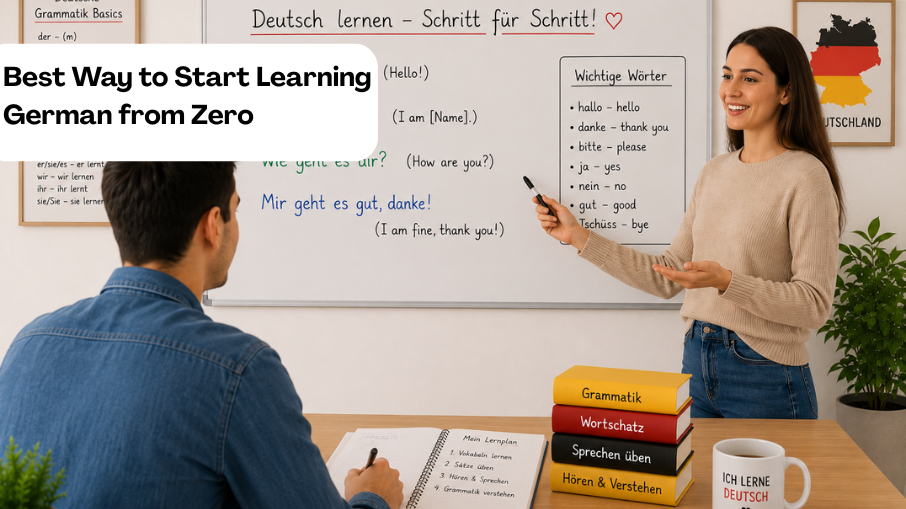
Best Way to Start Learning German from Zero
Staring at your first German word and feeling a little lost? You’re not alone. Almost everyone who starts from zero feels the same mix of excitement and nerves. The good news is that the best way to start learning German from zero isn’t complicated at all. It just needs the right steps, done in the right order. Germany is home to Europe’s largest economy, and German is spoken by over 100 million people across Europe, opening doors to study, jobs, and travel. This blog walks you through exactly how to begin, so you can skip the confusion and start speaking with confidence. Why Learn German From Zero? Learning a new language from scratch can feel scary, but German rewards you quickly once you get past the basics. Career and Study Opportunities in Germany Germany offers free or low-cost education at many public universities, and its job market actively welcomes skilled workers from abroad. Knowing German gives you a real edge, whether you’re applying to a university program or a company with German ties. Is German Really That Hard? Many beginners assume German is one of the toughest languages out there. In truth, English and German share the same language family, so you already know more words than you think (hallo, mutter, house/Haus). The grammar takes practice, but it’s learnable step by step. 7 Steps to Start Learning German as a Complete Beginner 1. Learn the Alphabet and Pronunciation First German pronunciation is mostly consistent once you learn the rules. Start here before jumping into vocabulary, so words don’t feel like guesswork. 2. Master Everyday Greetings and Phrases Simple lines like “Wie geht’s?” (how are you?) or “Ich heiße…” (my name is…) build early confidence and make the language feel real. 3. Build a Simple Grammar Foundation Focus on basics: articles (der, die, das), simple verb endings, and word order. Don’t try to learn every rule at once. 4. Grow Your Vocabulary Daily Learn 5-10 new words a day tied to real situations — shopping, greetings, food. Small, steady steps beat cramming. 5. Practice Listening Every Day German podcasts, songs, or beginner-level shows train your ear to recognize sounds and rhythm, even before you understand every word. 6. Speak From Day One Don’t wait until you feel “ready.” Say words out loud, talk to yourself, or practice with a partner. Mistakes are part of learning, not a sign of failure. 7. Follow a Structured Course Instead of Random Learning Jumping between random apps and videos can slow you down. A structured A1 course gives you a clear path, so you’re not guessing what to learn next. Self-Study vs. Joining a German Course — Which Is Better? Learning Alone: Pros and Cons Self-study is flexible and low-cost, but it’s easy to lose motivation or pick up wrong pronunciation habits without anyone to correct you. Why Guided Learning Speeds Things Up Learners in a structured class often reach a conversational A1-A2 level in a few months, while self-taught learners without guidance can take much longer simply because there’s no clear roadmap or feedback. Common Mistakes Beginners Make Skipping pronunciation basics and picking up bad habits earlyMemorizing grammar rules without ever using them in real sentencesAvoiding speaking out of fear of sounding wrong, which only slows progress How Long Does It Take to Learn Basic German? Most beginners reach a comfortable A1 level in 8-12 weeks with regular practice — around 3-4 hours a week. Progress depends on how often you practice, whether you already know another European language, and whether you’re following a clear plan or learning randomly. Best Resources and Tools for Beginners Apps, YouTube channels, and beginner textbooks are great for daily practice. But free resources often lack structure and feedback — two things that matter most when you’re starting from zero. FAQs Q1.Is German hard to learn for English speakers?Not as hard as people assume. English and German share many roots, which makes vocabulary easier to pick up than expected. Q2. How many hours a day should a beginner study German?Even 20-30 minutes daily, done consistently, works better than occasional long study sessions. Q3. Can I learn German on my own without a teacher?Yes, but progress is usually slower and pronunciation mistakes can go unnoticed without feedback. Q4. What’s the best level to start with?A1 is the standard starting point for complete beginners and builds the foundation for everything after. Q5. How much German do I need for study or work in Germany?Most university and job pathways require at least B1 or B2 level German, though some programs accept A2. Q6. Is it possible to learn German in 3 months?You can reach a solid A1 level in that time with regular practice, though fluency takes longer and steady effort. Ready to Start? Let ASAP German Language Institute Guide You ASAP German Language Institute is run by professional linguists and German language teachers with 15+ years of experience in teaching, translation, interpretation, and editing. They have helped students, professionals, and corporates across language, cultural, and business fields — all with a practical, real-world approach to learning. Ready to begin your German journey? Get in touch with ASAP German Language Institute, Pune and take your first real step toward a future that speaks German. To enroll or learn more about our German courses, visit our website or call us at +91-9209203333. Our expert trainers at ASAP German Language Institute are here to guide you every step of the way. Follow us on our social media for helpful tips, updates, and insights on learning German. Facebook– https://www.facebook.com/asapgerman Instagram– https://www.instagram.com/asap_german.com_ Website– https://www.asapgerman.com/ If you have any queries about our German courses or learning levels, click to send us a WhatsApp message. Our expert trainers will be happy to assist you.

Goethe A1 Exam Preparation: Complete Guide for Beginners
Thinking about taking the Goethe A1 exam but not sure where to start? You are not alone. Every year, thousands of students, job seekers, and visa applicants in India begin their German language journey with this very exam. The good news? A1 is the easiest level in the Goethe scale, and with the right plan, you can clear it without stress. This guide walks you through everything you need to know about Goethe A1 exam preparation — from the exam pattern to simple daily tips that actually work. What Is the Goethe A1 Exam? The Goethe A1 exam tests your basic understanding of the German language. It checks whether you can introduce yourself, ask simple questions, and understand everyday conversations. This level is the starting point for anyone learning German, whether your goal is studying abroad, working in Germany, or applying for a spouse visa. Why Goethe A1 Matters for Beginners Passing A1 proves you have the basic language skills needed for daily life in Germany. Many visa applications and job processes require this certificate as proof. Who Should Take This Exam? Students planning to study in Germany, professionals looking for work opportunities, and people applying for family reunion visas all need this certificate. Goethe A1 Exam Pattern and Syllabus The exam has four sections: Listening, Reading, Writing, and Speaking. Each section tests a different skill, so your Goethe A1 exam preparation should cover all four equally. The 4 Sections Explained • Listening: Short audio clips followed by simple questions• Reading: Short texts like notices, emails, or ads• Writing: A short letter or form-filling task• Speaking: A short conversation with an examiner How Marks Are Divided Each section carries equal weight, so ignoring even one part can affect your overall score. How Long Does It Take to Prepare for Goethe A1? This is one of the most common questions beginners ask. On average, most learners need 6 to 8 weeks of steady practice to feel exam-ready, though this depends on how much time you can give daily. Timeline for Working Professionals If you can study for just 30 to 45 minutes daily, 2 months is a realistic goal. Timeline for Students Students with more free time can often prepare in 4 to 6 weeks with focused daily practice. 7 Simple Tips to Prepare for Goethe A1 Here are practical steps that make your Goethe A1 exam preparation easier and more effective. 1. Build vocabulary daily – Learn 10 new words every day instead of cramming hundreds at once. 2. Practice listening with German audio – Podcasts, songs, and short videos train your ear. 3. Master basic grammar rules – Focus on articles, verb conjugation, and sentence order. 4. Practice speaking out loud – Talk to yourself, a friend, or a teacher daily. 5. Solve previous year papers – This helps you understand the real exam pattern. 6. Time yourself during practice – This builds confidence for the actual exam day. 7. Join a structured course – A guided course keeps you accountable and on track. https://youtu.be/Yjw8g6UGh9M?si=SjLxFvsRelXCiXxL Common Mistakes Beginners Make Avoiding these mistakes can save you from unnecessary stress and repeat attempts. Ignoring Speaking PracticeMany students focus only on writing and grammar, then panic during the speaking round. Daily speaking practice is non-negotiable. Cramming Grammar Instead of PracticingMemorizing rules without using them in sentences rarely works. Practice using grammar in real conversations instead. Not Practicing With a TimerThe exam is time-bound. If you never practice under time pressure, the real exam can feel rushed and stressful. Goethe A1 Exam Fees and Registration Exam fees vary depending on the exam center and city, so it’s best to check the latest fee structure directly on the official Goethe Institute website before registering. Registration is usually done online, and slots can fill up quickly during peak seasons, so applying early is a smart move. Why Learn German at This Level? Learning German opens doors beyond just passing an exam. Career Opportunities in Germany Germany has a growing demand for skilled workers, and basic German skills can boost your job applications significantly. Study Abroad Benefits Many German universities offer low-cost or free education, but a good grasp of the language makes settling in much easier. Frequently Asked Questions Q1. Is the Goethe A1 exam hard for beginners?No, A1 is designed for absolute beginners. With consistent daily practice, most learners find it manageable. Q2. How many hours a day should I study for Goethe A1?Around 30 to 60 minutes daily is enough if you stay consistent. Q3. Can I clear Goethe A1 in one month?Yes, if you can dedicate 1 to 2 hours daily and focus on all four sections equally. Q4. What is the passing score for Goethe A1?You generally need to score at least 60% overall to pass, with a minimum score required in each section. Q5. Is speaking practice really necessary for A1?Yes. Many students lose marks here simply because they didn’t practice speaking regularly before the exam. Ready to Start? Let ASAP German Language Institute Guide You ASAP German Language Institute is run by professional linguists and German language teachers with 20+ years of experience in teaching, translation, interpretation, and editing. They have helped students, professionals, and corporates across language, cultural, and business fields — all with a practical, real-world approach to learning. Ready to begin your German journey? Get in touch with ASAP German Language Institute, Pune and take your first real step toward a future that speaks German. To enroll or learn more about our German courses, visit our website or call us at +91-9209203333. Our expert trainers at ASAP German Language Institute are here to guide you every step of the way. Follow us on our social media for helpful tips, updates, and insights on learning German. Facebook– https://www.facebook.com/asapgerman Instagram– https://www.instagram.com/asap_german.com_ Website– https://www.asapgerman.com/ If you have any queries about our German courses or learning levels, click to send us a WhatsApp message. Our expert trainers will be happy to assist you.

Career Opportunities After Learning German.
Did you know that German is the most widely spoken native language in Europe, with over 130 million speakers worldwide? Yet when most people think about learning a new language for career growth, German rarely comes to mind first. That’s actually good news for you — because fewer competitors means more opportunity. If you’ve been learning German and wondering “what’s next?” — you’re in the right place. This blog breaks down the real, practical career opportunities after learning German, what salaries look like, and how to position yourself for success. Why German Is One of the Smartest Languages to Learn for Your Career Germany holds the position of the 4th largest economy in the world. Over 3,000 German companies operate in India alone — names like Bosch, Siemens, BMW, SAP, and Volkswagen. Germany is also India’s largest trading partner in Europe. Here’s the thing: German speakers are genuinely hard to find. Demand consistently outpaces supply, which means employers are often willing to pay a premium for candidates who bring this skill to the table. Studies show that bilingual professionals earn anywhere from 5% to 20% more than their monolingual peers. That gap gets even wider for less common languages like German. Top Career Opportunities After Learning German 1. Translator and InterpreterThis is one of the most direct career opportunities for German language learners. Translators work across legal, medical, technical, and literary fields. You can go the freelance route or work full-time with a firm or government body.In India, translators with strong German skills earn between ₹3–8 LPA, and those working in specialised fields like legal or medical translation earn significantly more. 2. Customer Support Executive (German Language)Large BPO and KPO companies like Concentrix, Teleperformance, and Sutherland regularly hire German-speaking customer support staff. This is one of the most accessible entry points — a B2 level of German is usually enough to qualify.Salary range: ₹4–7 LPA. A solid starting point with real room to grow. 3. Corporate Jobs with German MNCsThis is where German language career opportunities really shine. Companies like Bosch, SAP, Bayer, Deutsche Bank, and Siemens have large offices across Indian cities. Their India-based teams frequently need employees who can communicate directly with German headquarters.Roles span across sales, HR, operations, finance, and marketing. Salary range: ₹5–15 LPA depending on your role and experience level. 4. German Language Teacher or TrainerAs more students and working professionals look to learn German, demand for good teachers keeps growing. You can teach at language institutes, schools, or online platforms like Italki, Preply, or Udemy.Many people start teaching part-time while working elsewhere — it’s a flexible option with strong earning potential. Salary range: ₹3–10 LPA, with online tutors serving international clients often earning more. 5. Content Writer or Editor (German)Businesses expanding into German-speaking markets — Germany, Austria, and Switzerland (collectively called the DACH region) — need good German content. Blog writing, copywriting, localization, and proofreading are all in demand.Freelancers working with European clients often earn in euros, which significantly boosts their income in real terms. Salary range: ₹4–12 LPA. 6. Travel and Tourism IndustryGermany, Austria, and Switzerland attract millions of tourists every year. Travel consultants, tour guides, and airline staff with German skills earn a clear salary advantage when dealing with European clients or tourists.If travel is your world, German gives you a genuine edge. 7. Higher Education and Research in GermanyGermany has over 400 public universities — many of which charge little to no tuition fees. German proficiency is often required for admission and is essential for scholarships like the DAAD (German Academic Exchange Service).Studying in Germany also opens the door to post-study work visas, giving you a long-term foothold in the European job market. 8. Import-Export and International TradeGermany is one of the world’s top manufacturing and export nations. Indian businesses that deal with German companies need staff who can communicate without going through a middleman. Roles like trade coordinator, procurement specialist, and logistics liaison are growing steadily. What Level of German Do You Need? German proficiency is measured using the CEFR scale — from A1 (complete beginner) to C2 (near-native fluency). Here’s a simple guide: A2–B1: Customer support roles, teaching assistantsB2–C1: Corporate jobs, content writing, translationC2: Legal or medical interpreting, senior professional roles B2 is the sweet spot for most jobs for German language learners in India. It’s achievable within 12–18 months with consistent, structured learning. Is Learning German Worth It in 2026? Absolutely. Beyond the salary advantage, German opens doors across multiple countries — Germany, Austria, Switzerland, Luxembourg, and more. You’re not just learning a language; you’re gaining access to one of the world’s most stable and well-paying job markets. In 2026, demand for skilled professionals in engineering, healthcare, IT, and research across German-speaking countries continues to remain strong, making German even more valuable for global career growth. The real question isn’t whether German is worth learning. It’s whether you’re learning it the right way. FAQ: Q1: What is the scope of German language in India?Very strong. Hundreds of German MNCs operate in India, and demand for German speakers consistently outpaces supply — making it one of the better-paying language careers available. Q2: Can I get a job after learning German at B2 level?Yes. B2 is the minimum requirement for most corporate and customer-facing roles, and many employers in India actively recruit at this level. Q3: How long does it take to learn German for a job?With consistent effort, reaching B2 takes roughly 12–18 months. Structured learning with qualified teachers speeds this up noticeably. Q4: What is the salary for German language jobs in India?Customer support roles start around ₹4 LPA, while corporate or technical roles range from ₹6–15 LPA. Freelancers working with international clients can earn more. Q5: Do I need to live in Germany to use German professionally?Not at all. India has a strong market for German speakers — especially in Pune, Bengaluru, Chennai, and Hyderabad where German companies have large operations. Q6: Is German hard to learn?It has a reputation for being complex, but with the

How Long Does It Take to Learn German Fluently?
So, you’ve decided to learn German — great choice! Maybe you’re dreaming of living in Berlin, landing a job in a German company, or simply connecting with German-speaking friends and family. Whatever your reason, one question is probably sitting in the back of your mind right now: how long does it take to learn German fluently? The good news is — it’s not as scary as it sounds. With the right plan and consistent effort, fluency is absolutely within your reach. Let’s break it down honestly and clearly. What Does “Fluent in German” Actually Mean? Before we talk numbers, it’s worth asking: what does fluency actually look like? Most language teachers use the CEFR scale (Common European Framework of Reference) to measure progress: A1–A2: Basic beginner — greetings, simple sentencesB1: Intermediate — handle travel, express opinionsB2: Upper intermediate — this is what most people mean by “fluent in German”C1–C2: Near-native and mastery level For most learners — whether for work, study, or daily life — B2 is the real target. At B2, you can hold complex conversations, read German articles, and function confidently in professional settings. So, How Long Does It Take to Learn German? According to the U.S. Foreign Service Institute (FSI), English speakers need around 750 hours of study to reach solid working proficiency in German. That sounds like a lot — but when you break it down by daily effort, it becomes very manageable. Study Time Approximate Time to Fluency 1 hour/day 2–3 years 2 hours/day 1–1.5 years Intensive immersion (4–6+ hrs/day) 6–12 months Casual study (a few hours/week) 3–5+ years The key takeaway? How long it takes to learn German fluently depends almost entirely on how much focused time you put in each day. 4 Things That Speed Up (or Slow Down) Your German Learning 1. Your Native LanguageEnglish speakers have a natural head start. German and English share hundreds of similar words — Wasser (water), Haus (house), Musik (music). This shared vocabulary gives you a running start from day one. 2. Consistency Over IntensityStudying 45 minutes every day will always beat a 5-hour weekend session. Your brain builds language skills through regular, repeated exposure — not cramming. 3. Quality of LearningThis is where most self-taught learners quietly struggle. Apps can teach you vocabulary, but they can’t correct your grammar in real time, explain why a rule works the way it does, or adapt to your specific weak spots. Learning German fluently is much faster when you have proper guidance from a qualified teacher. 4. How Much You Actually Use GermanWatching German TV shows, listening to German podcasts, or chatting with native speakers — even for 20 minutes a day — makes a huge difference. The more you use the language outside of study time, the faster it sticks. Is German Really That Hard? Honestly — German grammar does have a reputation. Four grammatical cases, three noun genders (der, die, das), and some very long compound words (ever heard of Donaudampfschifffahrtsgesellschaft?) can feel overwhelming at first. But here’s the thing: German is very logical. Once you understand the patterns, everything starts to follow rules consistently. Unlike English, German spelling and pronunciation are almost perfectly predictable. Many learners find that after the first few months, German becomes far more straightforward than they expected. A Simple Month-by-Month German Learning Timeline Here’s what steady progress looks like for someone studying around 1 hour per day: Months 1–3 (A1): Learn basic greetings, numbers, and everyday vocabulary. Introduce yourself confidently. Months 4–6 (A2): Handle shopping, directions, and simple conversations. Build a vocabulary of around 1,500 words. Months 7–12 (B1): Express opinions, understand clear speech, read simple texts and emails comfortably. Months 13–24 (B2): Hold complex conversations, read German articles and reports, communicate naturally with native speakers. This is fluency — and it’s very achievable. 5 Tips to Learn German Faster 1. Start speaking from week one. You don’t need to be perfect. Speaking early builds confidence fast. 2. Focus on the top 1,000 words first. They cover around 85% of everyday conversation. 3. Use spaced repetition for vocabulary. Tools like Anki show you words right before you forget them — scientifically proven to boost memory. 4. Watch German TV with German subtitles. Shows like Dark or Tatort are brilliant for training your ear while picking up natural speech. 5. Work with a qualified German teacher. Real-time feedback, grammar explained in context, and structured lessons cut months off your learning timeline. FAQ: How Long Does It Take to Learn German? Q1. How long does it take to learn German to B2?Around 18–24 months with 1 hour of daily study and proper guidance. Intensive learners can reach B2 in 8–12 months. Q2. Can I become fluent in German in 1 year?Yes — with 2–3 hours of daily study, real immersion, and a good teacher, reaching B2 in 12 months is absolutely possible. Q3. Do I need to live in Germany to become fluent?No. Thousands of learners reach fluency entirely online through teachers, German media, and virtual practice. Q4. Is 30 minutes a day enough to learn German fluently?It’s enough for steady progress, but your timeline will stretch to 4–5 years. More daily time — or sessions with a qualified teacher — speeds things up significantly. Q5. What is the hardest part of learning German?Most learners find the four grammatical cases and noun genders the trickiest early on. With a good teacher explaining the logic behind them, they become much easier to manage. Ready to Start? Let ASAP German Language Institute Guide You ASAP German Language Institute is run by professional linguists and German language teachers with 20+ years of experience in teaching, translation, interpretation, and editing. They have helped students, professionals, and corporates across language, cultural, and business fields — all with a practical, real-world approach to learning. Ready to begin your German journey? Get in touch with ASAP German Language Institute, Pune and take your first real step toward a future that speaks German. To enroll or learn more about our
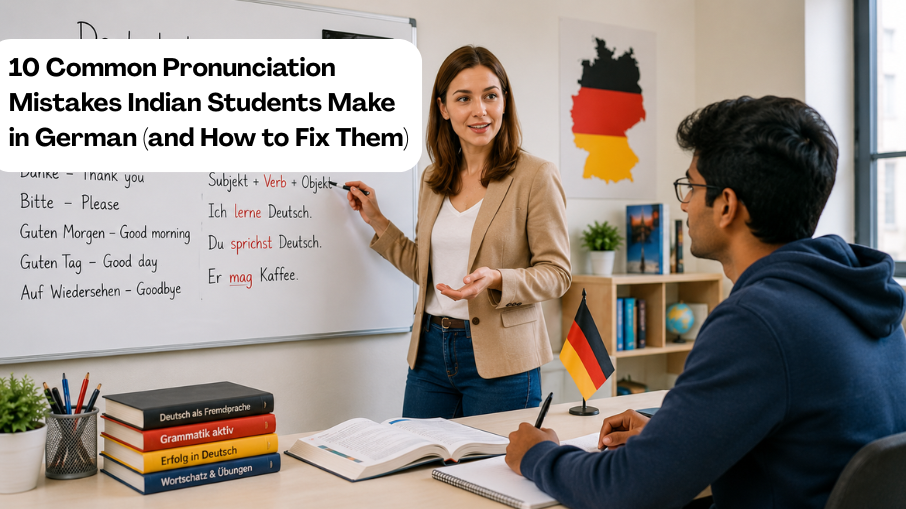
10 Common Pronunciation Mistakes Indian Students Make in German (and How to Fix Them)
So you’ve been learning German for a while now. But the moment you speak out loud — something feels off. Native speakers pause. They ask you to repeat yourself. Sound familiar? Here’s the truth: German pronunciation mistakes Indian students make are incredibly common — and completely understandable. Your brain is wired for the sounds of Hindi, Tamil, Telugu, or Bengali. German asks your mouth to do things it has never done before. The good news? Once you know exactly what’s going wrong, fixing it is faster than you think. Here are the 10 biggest pronunciation mistakes and how you can correct them. 1. Rolling the “R” Like in Hindi or English The German “R” is not the rolled Hindi “र” or the soft English “r.” It lives deep in the throat — almost like a gentle gargle. Most Indian learners push it too far forward. Fix: Practise gargling water. Control that sound dry, and you’ve found your German R. Try: rot, Recht, fahren. 2. Treating “ch” as One Sound This is one of the most common German pronunciation errors Indian learners run into. German “ch” has two sounds. After a, o, u — it’s a deep throat sound (like the Punjabi ਖ਼). After e, i, ä — it’s a soft hiss, like whispering “hyuh.” Fix: The word ich uses the soft version. Say “huge” in a British accent — that opening sound is very close. 3. Skipping Umlauts: ä, ö, ü Umlauts don’t exist in English or most Indian languages, so learners either skip them or replace them with familiar vowels. This changes word meanings entirely. Mutter (mother) and Mütter (mothers) are two completely different words. Fix: For ü — say “ee,” keep your tongue there, and round your lips into an “O.” Practise: über, grün, fühlen. 4. Saying “W” Like the English “W” In German, “W” is always a “V” sound. Always. Indian students who’ve grown up with English automatically say “w” — which immediately stands out to German ears. Fix: Every time you see “W” in German, read it as “V.” Wasser = “Vasser.” Welt = “Velt.” Simple rule, big difference. 5. Saying “V” Like the English “V” The flip side of Mistake 4. German “V” sounds like “F” in most native German words. So Indian students learning German pronunciation often get both W and V backwards — saying the wrong sound for each letter. Fix: Vater = “Fater.” Vier = “Feer.” Think of V as F unless it’s a borrowed word like Visum or Volleyball. 6. Mixing Up “ei” and “ie” This trips up nearly every Indian learner. “ei” sounds like “eye.” “ie” sounds like “ee.” Swap them and you’ll say something completely different from what you intended. Fix: Look at the second letter. “ei” ends in “i” — say “eye.” “ie” ends in “e” — say “ee.” mein rhymes with “mine.” viel rhymes with “feel.” 7. Voicing Final Consonants German has a rule called Auslautverhärtung — at the end of a word, voiced consonants (b, d, g) become unvoiced (p, t, k). Indian learners, following natural instinct, keep the voiced sound. Fix: Hund ends like “hunt.” Abend ends like “Abent.” Tag ends like “Tak.” It feels strange at first, but it quickly becomes automatic. 8. Pronouncing “Z” Like English “Z” The buzzing English “Z” does not exist in German. German “Z” is a sharp “ts” — like the end of the word “cats” or the “zz” in “pizza.” Fix: Every German “Z” = “ts.” Zeit = “Tsyte.” Zehn = “Tsen.” This is one of the most mispronounced German sounds by Indian students and also one of the easiest to correct once you know the rule. 9. Stressing the Wrong Syllable Most native German words are stressed on the first syllable. Indian learners — especially those influenced by English or Hindi stress patterns — often land on the wrong beat. Fix: When learning a new word, mark the stress. Say it out loud with the first syllable louder. MUT-ter, VER-stehen, DAN-ke. Listening to native speakers on platforms like Forvo helps a lot here. 10. Getting Vowel Length Wrong German vowels are either short and clipped, or long and open — and the difference can change a word’s meaning. offen (open) has a short “o.” Ofen (oven) has a long “o.” Indian learners often miss this distinction entirely. Fix: Vowel before a double consonant (nn, ll, tt)? Keep it short. Vowel before a single consonant or followed by “h”? Stretch it out. kam vs Kamm. Weg vs weg. FAQs Q1. How long does it take to fix German pronunciation for Indian learners?Most learners notice real improvement within 4–8 weeks of focused practice. Specific sounds like the German R or Umlauts can shift in just a few guided sessions. Q2. Is German pronunciation harder for Indian students than for English speakers?Not necessarily. Indian language speakers already handle complex sounds and vowel distinctions. The challenge is mainly unlearning English habits. With the right guidance, Indian learners often progress quickly. Q3. Can I fix these mistakes using apps alone?Apps help with listening, but they can’t hear you. Real improvement — especially in pronunciation — comes from a teacher who gives live feedback on exactly what your mouth is doing. Q4. Do I need to sound like a native German speaker?No. Clear, intelligible German is the goal. The 10 mistakes above cause genuine misunderstandings, so fixing them matters — but a light Indian accent is perfectly fine and even charming. Ready to Start? Let ASAP German Language Institute Guide You ASAP German Language Institute is run by professional linguists and German language teachers with 20+ years of experience in teaching, translation, interpretation, and editing. They have helped students, professionals, and corporates across language, cultural, and business fields — all with a practical, real-world approach to learning. Ready to begin your German journey? Get in touch with ASAP German Language Institute, Pune and take your first real step toward a future that speaks German. To enroll or learn more about our German
