
Once you have finished A1, the next step for most learners is A2. At this level you move from basic phrases to handling routine situations with more confidence: describing your past, making plans, writing short emails and understanding everyday announcements. Before you start preparing, it helps to know exactly what the A2 exam covers and how it is structured.
This article explains the German A2 exam syllabus and format, based on the Goethe-Zertifikat A2, with notes on telc where useful.
What Is the German A2 Level?
A2 is the second level of the Common European Framework of Reference for Languages (CEFR), also called elementary or “Waystage” level. At A2, you can understand frequently used sentences and expressions about familiar topics, communicate in simple routine tasks and describe your background and immediate surroundings in simple terms.
In practical terms, an A2 learner can talk about family, work, shopping, travel, health and free time, and can deal with simple everyday situations in German.
German A2 Exam Syllabus: Topics You Should Know
The exam does not publish a fixed list of questions, but it draws on everyday topics linked to the CEFR A2 level. Common themes include:
- Personal information: family, friends, home, background
- Daily routine and free time: hobbies, weekends, sport, holidays
- Work and education: jobs, workplace, school, courses
- Shopping and services: prices, clothes, groceries, bank, post office
- Food and eating out: restaurants, ordering, recipes
- Travel and transport: tickets, timetables, directions, hotels
- Health: body parts, illness, doctor’s appointments
- Housing: flats, rooms, furniture, moving
- Weather and seasons
- Celebrations and invitations: birthdays, parties, festivals
Grammar for the A2 Exam
You are expected to use A1 grammar confidently and build on it. Key A2 grammar areas include:
- Perfekt: talking about the past (Ich habe gegessen, ich bin gefahren)
- Präteritum of sein, haben and modal verbs: war, hatte, konnte, musste
- Dative case: with articles, pronouns and prepositions (mit dem Bus, bei mir)
- Two-way prepositions: in, auf, an with accusative or dative
- Subordinate clauses: with weil, dass, wenn and the verb at the end
- Reflexive verbs: sich freuen, sich waschen
- Comparatives and superlatives: größer, am größten
- Adjective endings in common patterns
- Konjunktiv II for politeness: Ich hätte gern …, Könnten Sie …?
Vocabulary
There is no official word count, but A2 learners should build a working vocabulary for the topics above. Learning words in phrases (einen Termin machen, eine Fahrkarte kaufen) is more useful than memorising single words.
German A2 Exam Format (Goethe-Zertifikat A2)
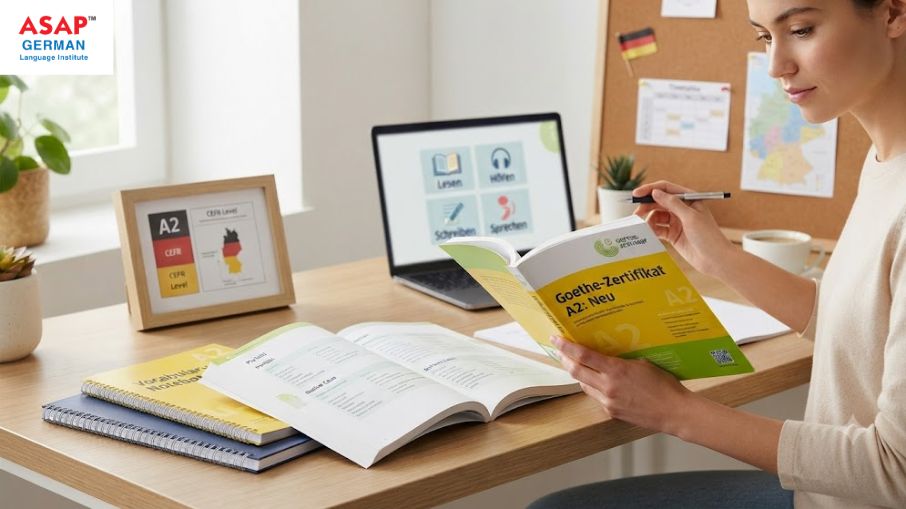
The Goethe-Zertifikat A2 has four sections: Lesen, Hören, Schreiben and Sprechen. Each is worth 25 points, for a total of 100.
| Section | Duration | Parts | Points |
|---|---|---|---|
| Lesen (Reading) | 30 minutes | 4 | 25 |
| Hören (Listening) | About 30 minutes | 4 | 25 |
| Schreiben (Writing) | 30 minutes | 2 | 25 |
| Sprechen (Speaking) | 15 minutes, usually in pairs | 3 | 25 |
The written exam (reading, listening and writing) lasts 90 minutes without a break. The speaking test is normally taken in pairs and lasts about 15 minutes, with no preparation time. In exceptional cases it may be held individually, which takes about 10 minutes. These details are set out in the Goethe-Institut’s A2 exam regulations (PDF).
How Is the A2 Exam Scored?
To pass the Goethe-Zertifikat A2, you need:
- At least 60 out of 100 points overall
- At least 45 points in the written part (reading, listening and writing together, out of 75)
- At least 15 points in the speaking part (out of 25)
If you do not reach both minimums, the whole exam counts as not passed. Unlike the B1 to C2 Goethe exams, the A2 exam is not modular, so you cannot pass or resit one section on its own.
Results are given with a grade:
| Points | Grade |
|---|---|
| 90 to 100 | sehr gut (very good) |
| 80 to 89 | gut (good) |
| 70 to 79 | befriedigend (satisfactory) |
| 60 to 69 | ausreichend (sufficient) |
| Below 60 | nicht bestanden (not passed) |
What About the telc A2 Exam?
telc also offers German exams at A2 level. The skills tested are the same, but the structure, timing and scoring are not identical to Goethe. If your university, employer or visa process accepts a specific certificate, confirm which one before you register. Details are available on the official telc website.
Who Needs the German A2 Certificate?
A2 is useful for learners who:
- Want to build a stronger base before B1
- Need proof of elementary German for certain courses or employers
- Are planning to live in Germany and want to manage daily life
- Want a structured goal while learning
Requirements for visas, jobs and universities change and vary, so always check the current requirement with the relevant authority or institution.
How Long Does It Take to Prepare for A2?
After completing A1, most learners need around two to three months of regular classes and practice to be ready for A2. This depends on how often you study, your A1 foundation and how much you practise speaking. Our Goethe A2 exam preparation guide shares a step-by-step plan.
Prepare for German A2 with ASAP
A structured course helps you cover the full syllabus and practise the exam format. ASAP offers German A2 classes in Pune and weekend Goethe exam preparation sessions.
ASAP German Language Institute is run by professional linguists and German language teachers with 20+ years of experience in teaching, translation and interpretation. Classes run at our Deccan, Wakad and Kharadi branches in Pune, and online.
To enrol or ask about batch timings, call +91-9209203333, or see the Contact page on our website for branch addresses and numbers.
Frequently Asked Questions
1. What is the passing mark for the Goethe A2 exam?
You need at least 60 out of 100 points overall. Of these, at least 45 must come from the written part and at least 15 from the speaking part. If either minimum is missed, the whole exam is not passed.
2. How long is the German A2 exam?
The written part (reading, listening and writing) takes 90 minutes without a break. The speaking part takes about 15 minutes in pairs, or about 10 minutes if held individually. It may be held on the same day or a different day.
3. Can I take the A2 exam without passing A1?
Yes. The Goethe-Institut does not require an A1 certificate to register for A2. However, A2 builds directly on A1 grammar and vocabulary, so a solid A1 foundation is important.
4. Is the A2 exam modular?
No. The Goethe-Zertifikat A2 is taken as one complete exam. If you do not pass, you need to retake all sections. Modular exams start from the Goethe B1 level.
5. Which grammar topics are most important for A2?
Perfekt, the dative case, two-way prepositions, subordinate clauses with weil and dass, modal verbs in the past and polite forms like ich hätte gern are commonly tested. Using them correctly in writing and speaking helps most.