

Did you know that German is the most widely spoken native language in Europe, with over 130 million speakers worldwide? Yet when most people think about learning a new language for career growth, German rarely comes to mind first. That’s actually good news for you — because fewer competitors means more opportunity.
If you’ve been learning German and wondering “what’s next?” — you’re in the right place. This blog breaks down the real, practical career opportunities after learning German, what salaries look like, and how to position yourself for success.
Why German Is One of the Smartest Languages to Learn for Your Career
Germany holds the position of the 4th largest economy in the world. Over 3,000 German companies operate in India alone — names like Bosch, Siemens, BMW, SAP, and Volkswagen. Germany is also India’s largest trading partner in Europe.
Here’s the thing: German speakers are genuinely hard to find. Demand consistently outpaces supply, which means employers are often willing to pay a premium for candidates who bring this skill to the table. Studies show that bilingual professionals earn anywhere from 5% to 20% more than their monolingual peers. That gap gets even wider for less common languages like German.
Top Career Opportunities After Learning German
1. Translator and Interpreter
This is one of the most direct career opportunities for German language learners. Translators work across legal, medical, technical, and literary fields. You can go the freelance route or work full-time with a firm or government body.
In India, translators with strong German skills earn between ₹3–8 LPA, and those working in specialised fields like legal or medical translation earn significantly more.
2. Customer Support Executive (German Language)
Large BPO and KPO companies like Concentrix, Teleperformance, and Sutherland regularly hire German-speaking customer support staff. This is one of the most accessible entry points — a B2 level of German is usually enough to qualify.
Salary range: ₹4–7 LPA. A solid starting point with real room to grow.
3. Corporate Jobs with German MNCs
This is where German language career opportunities really shine. Companies like Bosch, SAP, Bayer, Deutsche Bank, and Siemens have large offices across Indian cities. Their India-based teams frequently need employees who can communicate directly with German headquarters.
Roles span across sales, HR, operations, finance, and marketing. Salary range: ₹5–15 LPA depending on your role and experience level.
4. German Language Teacher or Trainer
As more students and working professionals look to learn German, demand for good teachers keeps growing. You can teach at language institutes, schools, or online platforms like Italki, Preply, or Udemy.
Many people start teaching part-time while working elsewhere — it’s a flexible option with strong earning potential. Salary range: ₹3–10 LPA, with online tutors serving international clients often earning more.
5. Content Writer or Editor (German)
Businesses expanding into German-speaking markets — Germany, Austria, and Switzerland (collectively called the DACH region) — need good German content. Blog writing, copywriting, localization, and proofreading are all in demand.
Freelancers working with European clients often earn in euros, which significantly boosts their income in real terms. Salary range: ₹4–12 LPA.
6. Travel and Tourism Industry
Germany, Austria, and Switzerland attract millions of tourists every year. Travel consultants, tour guides, and airline staff with German skills earn a clear salary advantage when dealing with European clients or tourists.
If travel is your world, German gives you a genuine edge.
7. Higher Education and Research in Germany
Germany has over 400 public universities — many of which charge little to no tuition fees. German proficiency is often required for admission and is essential for scholarships like the DAAD (German Academic Exchange Service).
Studying in Germany also opens the door to post-study work visas, giving you a long-term foothold in the European job market.
8. Import-Export and International Trade
Germany is one of the world’s top manufacturing and export nations. Indian businesses that deal with German companies need staff who can communicate without going through a middleman. Roles like trade coordinator, procurement specialist, and logistics liaison are growing steadily.
What Level of German Do You Need?
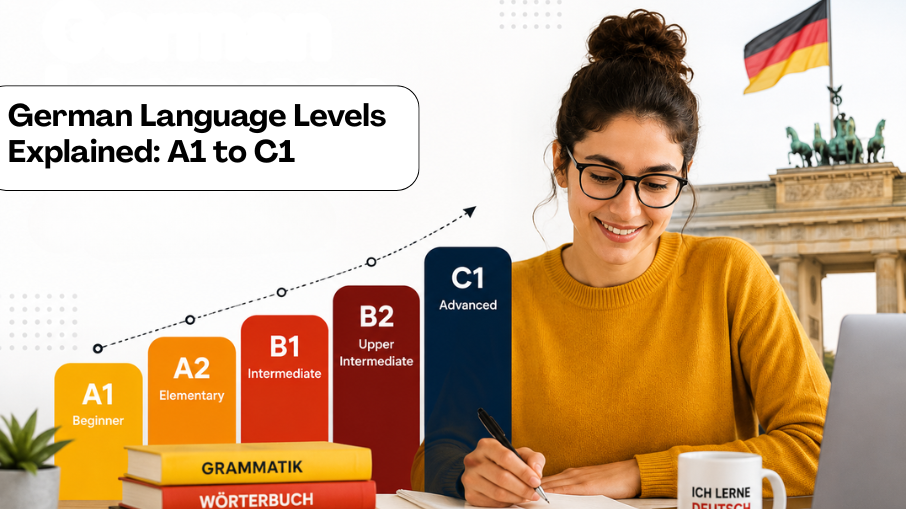
German proficiency is measured using the CEFR scale — from A1 (complete beginner) to C2 (near-native fluency).
Here’s a simple guide:
A2–B1: Customer support roles, teaching assistants
B2–C1: Corporate jobs, content writing, translation
C2: Legal or medical interpreting, senior professional roles
B2 is the sweet spot for most jobs for German language learners in India. It’s achievable within 12–18 months with consistent, structured learning.
Is Learning German Worth It in 2026?
Absolutely. Beyond the salary advantage, German opens doors across multiple countries — Germany, Austria, Switzerland, Luxembourg, and more. You’re not just learning a language; you’re gaining access to one of the world’s most stable and well-paying job markets.
In 2026, demand for skilled professionals in engineering, healthcare, IT, and research across German-speaking countries continues to remain strong, making German even more valuable for global career growth.
The real question isn’t whether German is worth learning. It’s whether you’re learning it the right way.
FAQ:
Q1: What is the scope of German language in India?
Very strong. Hundreds of German MNCs operate in India, and demand for German speakers consistently outpaces supply — making it one of the better-paying language careers available.
Q2: Can I get a job after learning German at B2 level?
Yes. B2 is the minimum requirement for most corporate and customer-facing roles, and many employers in India actively recruit at this level.
Q3: How long does it take to learn German for a job?
With consistent effort, reaching B2 takes roughly 12–18 months. Structured learning with qualified teachers speeds this up noticeably.
Q4: What is the salary for German language jobs in India?
Customer support roles start around ₹4 LPA, while corporate or technical roles range from ₹6–15 LPA. Freelancers working with international clients can earn more.
Q5: Do I need to live in Germany to use German professionally?
Not at all. India has a strong market for German speakers — especially in Pune, Bengaluru, Chennai, and Hyderabad where German companies have large operations.
Q6: Is German hard to learn?
It has a reputation for being complex, but with the right teacher and method, most learners find it very manageable. The grammar takes time, but pronunciation is consistent and logical once you get the basics down.
Ready to Start? Let ASAP German Language Institute Guide You
ASAP German Language Institute is run by professional linguists and German language teachers with 15+ years of experience in teaching, translation, interpretation, and editing. They have helped students, professionals, and corporates across language, cultural, and business fields — all with a practical, real-world approach to learning.
Ready to begin your German journey? Get in touch with ASAP German Language Institute, Pune and take your first real step toward a future that speaks German.
To enroll or learn more about our German courses, visit our website or call us at +91-9209203333. Our expert trainers at ASAP German Language Institute are here to guide you every step of the way.
Follow us on our social media for helpful tips, updates, and insights on learning German.
Facebook– https://www.facebook.com/asapgerman
Instagram– https://www.instagram.com/asap_german.com_
Website– https://www.asapgerman.com/
If you have any queries about our German courses or learning levels, click to send us a WhatsApp message. Our expert trainers will be happy to assist you.