
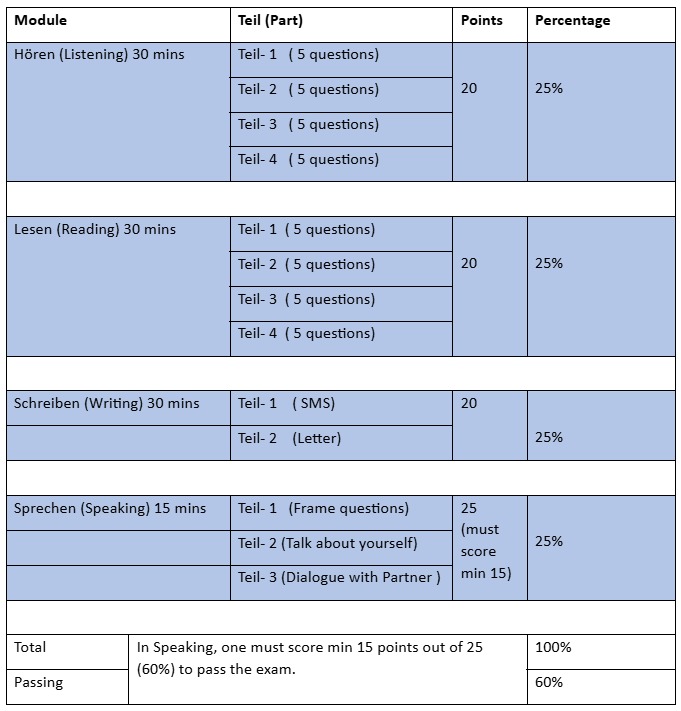
Goethe German A2 exam details The German A2 exam pattern is quite simple. As it’s a language, there are 4 modules- Reading, Writing, Listening and Speaking. It is a 60-point exam, and you have to score a minimum of 36 points (60%) to pass the exam. What does the Goethe A2 Exam cover? The A2 exam consists of 4 modules or parts, 15 points each so total of 60 points. 1. Listening (Hören) 2. Reading (Lesen) 3. Writing (Schreiben) 4. Speaking (Sprechen) Note- Don’t forget to watch the videos on our YouTube channel. I have solved one Goethe Institut A2 sample question paper for you. Read the blog first; this will make your understanding better. Here you will see the Goethe A2 sample question paper provided on their website for practice purposes. You can download the German A2 exam practice material from the Goethe Institute’s official website. The same link we have given at the end of the blog. We suggest reading the complete blog before downloading the practice material. Let’s talk about these four modules in detail now- 1. Listening (Hören) module – Time- 30 min, Points- 20 There are four parts (Teil) in the listening module. Let’s see in detail- Listening (Hören) Part 1 (Teil 1) – 5 points This consists of 5 questions (1-5), and there will be 5 audio dialogues. You’ll have a question, and there will be 3 options- A, B and C. All 5 audios are played twice. You get enough time to understand the question and select your answer. If you listen carefully, you can easily find the answers. Make sure to read the question and options before the audio starts. See the image below. Listening (Hören) Part 2 (Teil 2) – 5 points Here you listen to only one audio for all the 5 questions (6-10). This consists of 5 elements and 9 images. You have to listen to the audio and match images with the elements (for ex. Days with the activities). One image will match the example, and the remaining images won’t have any element to match with. The audio is mostly a conversation between two people and will be played only once. In the sample question given below, you have to match the activities with the days. In the image, you see only 6 images, but there will be 3 more below (a, b, …. upto i ). Please note that the number ‘0’ is an example. Listening (Hören) Part 3 (Teil 3) – 5 Points You will get 5 questions (11 to 15) and 5 Audios here and again, there will be A, B, and C options to every question. Here, the options will be the images. You have to listen to the audio carefully and select the answer. Every audio here is played only once. Listening (Hören) Part 4 (Teil 4) – 5 points Here you listen to only one audio (an interview) for all the 5 questions (16-20). This consists of 5 statements. You have to listen to the audio and decide if the statement is true (select Yes) or false (select No). The audio is mostly a conversation/interview and will be played twice. Please note that the number ‘0’ is an example. 2. Reading (Lesen) module of Goethe A2 exam- 30 mins, 20 Points Again, there are 4 parts of the reading module. Part 1 (medium size text) – 5 points for 5 questions – Complete the statements Part 2 (Shopping centre info-board) – 5 points for 5 questions – a, b or c Part 3 (read the Email) – 5 points for 5 questions of multiple-choice type- a, b or c Reading (Lesen) Part 1 (Teil 1) – 5 points Here, one text is given to read, and there will be 5 incomplete statements with 3 options a, b and c. You have to find out which option completes the statement correctly according to the text. You can see the text in the image below and the questions below that. Text- Statements to complete- Reading (Lesen) Part 2 (Teil 2) – 5 points In this part, you will get an information Board of one shopping mall, where you can see on which floor what things are available. You will get 5 requirements here. For example, you want to drink coffee in that mall. There will be three options given: a. 1st Floor, b. Ground floor and c. 5th floor. You have to choose the correct option. Read the information board and find out where you can get coffee to drink. ‘Beispiel’ or ‘0’ number question is an example in the image below. Information board- Questions- Reading (Lesen) Part 3 (Teil 3) – 5 points Here you will get an email to read, and there will be 5 incomplete statements (questions 11-15) with 3 options a, b and c, similar to Teil 1. You have to find out which option completes the statement correctly according to the email. Email- Statements- Reading (Lesen) Part 4 (Teil 4) – 5 points In this part, you will get 5 requirements (questions 16-20) from five different people in the statement form, and there will be 6 website screenshots. You have to read the information given in the 6 website screenshots and match them with the requirements. One website already matches the example. so 5 remaining screenshots are for five statements. Requirements- Websites- 3. Writing (Schreiben) module of Goethe A2 exam- 20 mins, 20 points In the writing module, there are only 2 parts. Part1 (write an SMS) Part2 (Letter/ email writing) Let’s see in detail. Writing (Schreiben) Part 1 (Teil 1) – SMS writing You have to write an SMS to your friend, colleague, or family member. The exact situation will be given in the question. You have to understand and write an SMS accordingly. Three points will also be mentioned in the question. Make sure to include all those points in your SMS. Here, you are not expected to
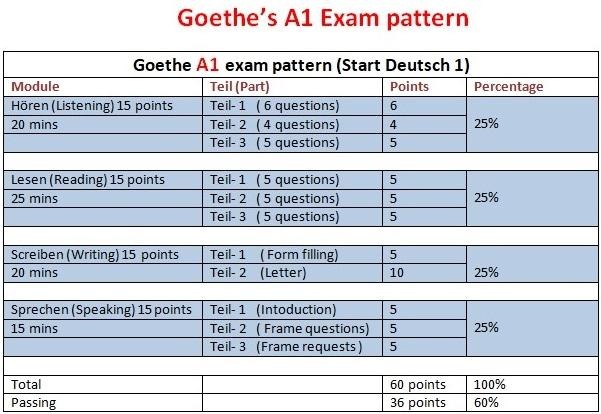
Goethe Institute A1 Exam pattern
To learn German at ASAP German Language Institute, please call/whatsapp us on +91-9209203333 or +91-9209206666. Details of Goethe’s A1 exam The German A1 exam pattern is quite simple. As it’s a language, there are 4 modules- Reading, Writing, Listening and Speaking. It is 60 points exam and you have to score 36 points (60%) to pass the exam. What does the Goethe A1 Exam cover? Goethe A1 exam consists of 4 modules or parts, 15 points each so total 60 points. You need to score a minimum of 36 points to pass the exam. Note- Don’t forget to watch the videos given below. I have solved one Goethe Institute A1 sample question paper for you ☺ Read the blog first, this will make your understanding better. Let’s talk about these four modules in details now- 1. Listening (Hören) module – Time- 20 min, Points- 15 There are three parts (Teil) in the listening module. Let’s see in detail- Hören Part 1 (Teil 1) –6 points This consists of 6 questions and there will be 6 audios- dialogs. You’ll have a question and there will be 3 options- A, B and C. All 6 audios are played twice. You get enough time to understand the question and select your answer. If you listen carefully you can easily find the answers. See the image below. Note- Beispiel means Example. Hören Part 2 (Teil 2) – 4 points This consists of 4 statements (7 to 10. 0 is an example in the image below) and 4 audios. Every audio will be played only once. You need to understand if the given statements are True (Richtig) or False (Falsch) according to the audio. The Audios played are mostly the announcements- in the shopping center, at the railway station or at the Airport. Watch the video below to learn and prepare this part in detail- Hören Part 3 (Teil 3) – 5 Points You will get 5 questions (11 to 15) and 5 Audios here and again there will be A, B, C options to every question. You have to listen to the audio carefully and select the answer. Every audio here is again played twice. Watch the video below to learn and prepare this part in detail- To learn German at ASAP German Language Institute, please call/whatsapp us on +91-9209203333 or +91-9209206666. 2. Reading (Lesen) module of Goethe A1 exam – 25 min, 15 Points Again there are three parts of the reading module. Lesen Part 1 (Teil 1) – 5 points Two texts (mostly small letters) are given and there will be 5 statements. You have to find out if the given statements are True (Richtig) or False (Falsch) according to the texts. Below you can see the example in the image. Watch the video below to learn and prepare this part in detail- Lesen Part 2 (Teil 2) – 5 points In every question here you will get two websites screenshots and a purpose is given. You need to understand which website (A or B) will help you to fulfill your purpose. Like this, there will be 5 questions and for every question, there will be two websites A and B, you have to select which website is helpful. Beispiel or 0 number question is an example in the image below. Watch the video below to learn and prepare this part in detail- Lesen Part 3 (Teil 3) – 5 points You will find one small text information or an advertising poster in each question. Here you will have 5 statements and you have to find out that the given statements according to the text are True (Richtig) or False (Falsch). Watch the video below to learn and prepare this part in detail- 3. Writing (Schreiben) module of Goethe A1 exam- 20 min, 15 points In the writing module, there are only 2 parts. Let’s see in detail. Schreiben Part 1 (Teil 1) – 5 points You will get text information about some person and one form to fill (for example hotel or flight booking form). You have to fill the form on behalf of that person. Read the question carefully. Please don’t fill your own info in the form 😉 Watch the video below to learn and prepare this part in detail- Schreiben Part 2 (Teil 2) – You will get one topic to write a letter or an email. With the topic, you also get three points which you have to use in the letter. Write around 5 to 6 lines (around 30 words) on the given three points. The letter is for 10 points. Watch the video below to learn and prepare this part in detail- To learn German at ASAP German Language Institute, please call/whatsapp us on +91-9209203333 or +91-9209206666. 4. Speaking (Sprechen) module of Goethe A1 exam-15 min, 15 points In the writing module, there are 3 parts. Speaking exam is done in groups of 3-4 students. Let’s see in detail. Sprechen Part 1 (Teil 1) – 5 points You have to introduce yourself on the key points provided. The examiner may ask to spell some word, your mobile number, your birth date or even email address with spelling. Answer everything carefully. Watch the video below to learn and prepare this part in detail- Sprechen Part 2 (Teil 2) – 5 points You have to ask your partner for some information. Here you will get a card, on the card there will be a theme given (for ex. Food and drink) and one word will be given (for ex. Sunday). You have to frame one question with the given theme and the word (for ex. What do you eat on Sunday?). You will get 2-3 cards and you have to frame 3 questions and your partner will answer your question. Same, your partner will also get cards and you will have to answer his or her questions in one or max two sentences. Watch the video below to learn and prepare this part in detail- Sprechen Part 3 (Teil 3) – You
How to write a letter/ an email in German A1 exam?
Goethe German A1 exam sample paper Schreiben Teil 2 (Writing part 2) What is Goethe A1 Exam Writing Part 2 or Schreiben Teil 2? There are two parts to the writing module of the Goethe A1 exam. This section covers the 2nd part of the Goethe’s A1 Written exam i.e. letter writing. What do you have to do in this part? The Goethe A1 exam Writing Part 2 focuses on letter writing. In this section, candidates receive a theme or topic along with three points. The task involves crafting a letter on the given theme, incorporating the provided three points within approximately 30 words or 5 sentences. This part of the exam carries a total of 10 points. As you start learning how to ace Writing Part 2, here’s a helpful tip: Take classes at the ASAP German Language Institute to get better at German. It’s a great way to get ready for this creative challenge by improving your language skills in a place that loves the German language. To make it easy to understand, we will divide the letters and emails into three categories: ‘du’ form: an informal letter to a single person In the ‘du’ form, your task involves crafting a letter to a friend. This implies that the letter should adopt an informal tone, as you will be addressing your friend personally. Therefore, it is important to incorporate terms such as “du,” “dich,” “dir,” and “dein(e)” throughout the letter. ’ ihr’ (you guys/you all) form: an informal letter to more than one In the ‘ihr’ form, your task involves composing a letter with a theme that requires addressing multiple friends informally. For instance, you might be writing a letter to two friends. In this context, it is essential to employ terms such as “ihr” (you guys), “euch,” and “euer/eure” throughout the letter to convey the informal tone and address multiple recipients. Sie form – Formal letter to one or many In the case of a formal letter theme, it is imperative to compose the letter in a formal tone. When addressing the recipient, utilize formal language by employing terms such as “Sie,” “Ihr(e),” and “Ihnen” to convey the appropriate level of formality in the communication. What are the most common errors one might make in letter writing? The primary mistake is a lack of proper understanding of the theme. It is crucial to thoroughly read the question or theme at least two to three times to grasp the given situation accurately. The second most prevalent error is a misunderstanding of the letter’s context and intended recipient. For instance, if the theme instructs you to respond as a guest to a friend’s birthday invitation, some students may mistakenly write as if it’s their own birthday, inviting the friend. This misinterpretation could result in a loss of all points, so it’s essential to exercise caution. The third commonly observed mistake is a failure to discern whether the letter should be formal or informal. It’s more accurate to say that students often overlook the formality aspect. Therefore, it’s crucial to pay attention and determine whether the letter should be formal or informal. In the case of an informal letter, ascertain whether you are addressing one friend or multiple friends, and accordingly decide whether to use the ‘du’ or ‘ihr’ form. For formal letters, use the ‘Sie’ form. The remaining errors typically pertain to grammar and are contingent on the individual’s proficiency in German, determined by the extent of their studies in the language. To learn German you can contact the ASAP German Language Institute. How to write a letter or email for the Goethe A1 exam? Salutations(Anreden) – Informal- (First names) Dear Carla – Liebe Carla, (female, e-ending) Dear Tom – Lieber Tom, (male, er-ending) Dear Friends – Liebe Freunde (Plural) Dear Maria and Hans – Liebe Maria, lieber Hans, Formal-(Surnames) Dear Mrs/Miss Harper – Liebe Frau Harper, Dear Mr. Harper – Lieber Herr Harper, If you writing a letter/ email to any company or organization and you don’t know the name of a person, then use the following salutation- Ladies and Gentlemen, Dear Sir or/and Madam – Sehr geehrte Damen und Herren, Letter/Email main text: Write 5–6 sentences on the given 3 points using simple A1 grammar. Closing lines- (Not mandatory) Ich freue mich auf dich/ euch/ Sie. – I am looking forward to seeing you. Ich warte auf deine/eure/Ihre Antwort. – I am waiting for your answer/reply. Closing greeting and signature- Informal- Liebe Grüße / Viele Grüße. Formal- Mit freundlichen Grüßen/ Viele Grüße. For a better understanding, we’ve provided three examples below. Additionally, there are 10 more letters for your practice. I am confident that completing these exercises will significantly enhance your performance in the Goethe A1 exam. Stay assured and best of luck! Sample question 1 – Informal plural (‘ihr’ form) Sie möchten Ihren Geburtstag feiern und Ihre Freunde Tom und Carla einladen. Schreiben Sie an Tom und Carla. (Include all three points given below.) Warum schreiben Sie? Tag und Uhrzeit? Wie kommen? Sample answer- Lieber Tom, liebe Carla, (Salutation) (Letter/email body below, around 30 words covering 3 points) (Start with lowercase.) ich habe Geburtstag am 3. Juli und möchte mit euch feiern. Ich lade euch für die Geburtstagsfeier am 4. Juli um 20 Uhr ein. Kommt bitte mit dem Bus Nummer 17 bis zur Vitra Park. Ich freue mich auf euch.(Closing line) Viele Grüße, (Closing greeting and signature) Anand B. Sample question 2: Informal singular (‘du’ form) Sie wollen heute Abend mit einem Freund/ einer Freundin ins Kino gehen. Sie sind aber krank und können nicht. Schreiben Sie Ihrem Freund/ Ihrer Freundin einen Brief. (You can write any name if a friend’s name is not mentioned in the question.) Warum schreiben Sie? Wie geht es Ihnen? Wann treffen? Sample answer- Sie möchten in der ASAP Sprachschule A1 Deutschkurs machen. Schreiben Sie am ASAP Institute. Warum schreiben Sie? Anmeldung und Gebühr? Termin? Sample question 3: Formal (‘Sie’ form) Liebe/r [Carla/Tom] (Female/Male friend) Leider muss ich heute absagen. Ich bin krank und kann heute
German Universities to Consider for your Studies Abroad
Students from across the world who are eager to further their education are flocking to Germany in ever-increasing numbers. And of course, it would. It has a very effective educational system, several top-tier colleges, and little or non-existent tuition costs. The latest data shows that there are more than 400 thousand international students currently enrolled in higher education institutions throughout German Universities. In addition, degrees from German institutions are widely recognized, so your credentials will be regarded across the world and the skills you pick up will give you a leg up when applying for jobs. Should you be considering studying in Germany, we have provided a list of the top universities in Germany for the year 2022. 1. The University of Technology in Munich The Technical University of Munich is widely considered as one of the top institutions of higher education in Europe due to its commitment to cutting-edge scholarship, innovative pedagogy, and enthusiastic support for the development of promising young minds. There are over 42,705 students enrolled in its various degree programs throughout its 15 faculties, with 32% coming from outside the United States. There are 566 faculty members at this school, and they all provide the excellent education that students need to succeed in their chosen fields. 2. The University of Heidelberg, Ruprecht-Karl This school has a long history of being globally focused research and teaching institution. This institution delivers high-quality instruction in warm, inviting classrooms so that its students may get a broader perspective and better equip themselves for the future. The University of Heidelberg is committed to fostering an inclusive and varied community of driven people and providing equal opportunities for men and women. 3. The University of RWTH Aachen When it comes to degrees and academic excellence, RWTH Aachen University is unrivaled. This institution, which is consistently ranked in Germany’s top 10, is a hub for cutting-edge research into the world’s most pressing problems. In addition, RWTH Aachen University grows in tandem with business, providing students with additional chances to learn what they need to know to be competitive in the international job market. There are around 45,628 students enrolled here, with 11,280 coming from other countries abroad. Final Thoughts Get in touch with Asap German Language Institute in Pune to know more about studying in Germany and to browse the reputed Universities situated in Germany.

German universities to consider for your studies abroad
The popularity of Germany as a study abroad destination is well-deserved. The German higher education system is often regarded as one of the most welcoming and progressive in the world, thanks in large part to the country’s dedication to internationalization. In addition, the cost of living is manageable, and tuition at public colleges in Germany is free for all students, regardless of nationality. Schiller International University The Schiller International University has campuses in both the United States and Europe, making it a truly global institution. Even though the “primary campus” is in Florida, the school really had its start as an American study abroad program in Heidelberg, Germany. Over a hundred different nationalities are currently represented among Schiller’s international student body. The university’s accreditation and foundation in the American educational system make it a popular choice among study abroad programs. English is the language of instruction throughout all campuses. More vocationally focused two- and four-year degree programs are available. The Freie University of Berlin The biggest of Berlin’s four research institutions, the highly regarded Freie Universität Berlin anticipates that one-third of its student body will be comprised of international students in the near future. The arts and humanities, as well as the social sciences, are the university’s strong suits, helping it to achieve a ranking of 130th in the QS World University Rankings in 2021. Having a presence in the United States, Belgium, Russia, China, Egypt, and India has allowed the university to strengthen its relationships with other institutions and better meet the needs of students in those regions. Berliner Humboldt-University At Humboldt University, overseas students make up more than 10% of the total student body. Humbolt University is one of the oldest institutions of higher education in Berlin, Germany. According to the QS World University Rankings for 2021, it was rated 117th worldwide. Humboldt is a rigorous research institution where students may collaborate with eminent experts in the disciplines of scientific history, quantitative economics, and environmental studies. There is a strong need for applications from students interested in doing scientific research. Final Thoughts Where you get the finest education and experience of German culture while studying abroad in Germany is up to you and your specific situation. To know more about studying abroad in Germany, contact Asap German Language Institute in Pune

German A1 Exam Details
Adults may test their German proficiency by taking the Goethe-Zertifikat A1: Start Deutsch one exam, often known as the German A1 Exam. It validates that applicants have attained the most fundamental language abilities and corresponds to the first level (A1) on the six-level scale of competence outlined in the Common European Framework of Reference for Languages (CEFRL) (CEFR). It is in possession of the Goethe Institut in Germany. In conjunction with a contract from the Goethe-Institut, the examination is carried out at authorized examination centers. Under the direction of the Institut, the exams are administered by the appropriate institutions, which also provide grades. The Goethe Institut is the entity that authorizes and oversees the issuance of certificates. Venue The test may be taken in any of the Goethe-Instituts that are spread across the nation or at any of the partner institutes that have been granted permission to administer it. It is recognized by educational institutions in Germany, leading to visa acceptance as well as employment opportunities. Applications If you pass the test, you will be able to converse effectively, comprehend and utilize common words that are used while shopping or work, as well as self-introduction and engagement with other people. It is good for the rest of your life, and there is no particular period when it will become invalid. On the other hand, certain educational institutions need a certificate of a recent study that was issued no more than two years ago. Specifics of Goethe’s A1 test are as follows: Reading, writing, listening, and oral communication are the four components that make up each sort of test. The length of the language test in its entirety is one hour and fifteen minutes. On the day of the examination, you will also be required to complete the Reading, Writing, Listening, and Speaking portions. To pass Goethe’s test, you will need to get a score of at least 36 out of a possible 60 points (or 60%).If the test was taken via the Goethe Institute, the results will be posted on the website within 10–15 business days; if Licensed Examiners were chosen, the results will be posted within 10 business days following the exam. Final Thoughts To know more about the details of the German A1 Exam, refer to the information provided by Asap German Language Institute in Pune.
Guide to German Language Exams: Goethe Examinations
Are you looking to pass the Goethe examination? One of the most popular German-language examinations is the Goethe-Zertifikat. This guide will assist you with some tips to help you succeed in the exam. 1. The time period available for preparation: You must start your preparation at least 8 months before the examination. You can even start one year before the examination if you want to crack it in one go. It is advisable that you should be working on your German language skills as early as possible so that you will have enough time to polish your skills before giving the exam. 2. Familiarize yourself with the exam pattern: It is very important that you know how much time you will give to each question and what kind of questions will be asked in the exam. To gain this knowledge, you can visit some websites or blogs where people have shared their experience of giving the exam. 3. Know what materials you need: Next, find out what materials you need to bring when you take the exam. Some tests might require pens only, while others might require pencils. You will also want to make sure that you get enough blank paper for all of the questions on the test, as well as a watch so that you don’t go over your time limit. 4. Check for testing sites regularly: Once you have confirmed your eligibility and determined when and where you will be taking the test, check for available testing sites frequently. During times of high demand, such as during school holidays or summer breaks, many sites fill up quickly. You might even have to travel across town just to find a space at an alternate location. 5. Know what to expect: The first thing you should do is find out everything you can about the exam, including what will be on it, how it’s administered and how much time you’ll have to complete it. You should also know how the test is graded. Conclusion: The Goethe exam is a major milestone that not many people reach in their German studies, but taking it is worthwhile if you want to certify your proficiency in the language. For more details, contact Asap German Language Institute in Pune
Why learn German- 10 Compelling Reasons
The German language may seem like any other foreign language to you but do you know adding this one language as an extra language in your resume can multiply your benefits in your already existing options or add more options to your available choices? Here are 10 compelling reasons that just might persuade you to learn German. Job Opportunities. Germany’s own Federal Employment Agency estimates that in order to meet its labor need, the nation requires approximately 400,000 skilled immigrants to migrate there annually. Along with being skilled and having relevant degrees, the only condition that they put forward to candidates is they should also know the German language, in order to bridge the gap between its national and international workers. Pretty standard right? Free and Quality education. Tuition fees for undergraduate students at all public German institutions were removed by all 16 states of Germany in 2014. This means everyone can study for free in Germany! That’s right, Germans, Europeans, and all non-Europeans can study in Germany for free, without having to pay tuition fees. With only a nominal charge per semester to pay administration fees and other expenditures, Germany provides its national and as well as international students with the best quality education. The German Language is easy to learn! The entire Internet seems to be set ablaze these days with its memes on how difficult it is to both pronounce and learn German, rest assured that it is one of the easiest languages to learn, and for its pronunciation, leave it to your teachers to train you! German is the fourth easiest language to learn if you are already an English speaker. This is due to the fact that German and English share the same Germanic root! As a result, there are thousands of words that are closely related to each other, for example, in German water becomes Wasser, sister becomes Schwester, while father becomes Vater. Furthermore, unlike in Chinese, Japanese, Korean, or Arabic, there is no new alphabet or whole new script to learn; instead, only four letters are added in the German Language. You already are aware of German letters if you know English, the letters are just pronounced differently here. German Culture: If you are fond of Europe and European culture, you will undoubtedly fall in love with Germany, which has a fascinating culture. Germany has a long and rich history, and it has been the heart of European ideas, politics, and art for almost 1,000 years. Even today, the culture is celebrated through its arts, museums, and festivals. This history has shaped a culture that combines literature, art, philosophy, logic, and reason, as well as a love of beer and sausages! The German language is the second most used language on the Internet! If you are someone who likes to broaden your social group, you would want to learn German. Because according to Statista, after English, German is the language spoken most on the internet. Also, the German’s ‘.de’ domain is the most popular domain after ‘.com’! Isn’t that fascinating? What better way could be to increase your friend circle while just sitting at home and surfing the internet? This means you also get the opportunity to practice the language with many native speakers. Hub for Science and Research. As you already know that Germany provides free and quality education, which attracts researchers and scientists from all over the world who want resources but are short on capital. Hence Germany is a popular location for Ph.D. students, postdoctoral researchers, and senior scientists. The country is known as the land of invention and innovation, and as a doorway for all those who want to explore the unknown world of science. Germany is the third greatest donor to R&D and provides research fellowships to international scientists. Along with that German is the second most widely used scientific language after English. Job opportunities worldwide. German corporations are the world’s most respected and trustworthy firms, providing solutions in a variety of industries such as automobiles and information technology. This has resulted in the companies expanding all over the world. This not only allows job seekers to work in Germany, but it also allows them to work anywhere throughout the globe. Apart from the requisite skills, the sole requirement from these companies is for you to be fluent in the German Language. Germans are everywhere. Whether it be in Europe or America, Germans are everywhere due to their nature of adaptability and they quite leave an impression on others with their presence due to their punctuality and ethics. This makes them easily likable and friendly. Hence you can find them everywhere! Also, a rather fun fact is that Germans are the ultimate travelers, with nearly six weeks of annual leave from work and a greater average salary than most other countries, they live their best life vacationing! This means that there’s a good chance you’ll stumble into a German speaker either on a business trip or on vacation. Germans are very warm and welcoming towards the one who speaks their language (Who isn’t?). You will make great friends everywhere you go if you know the German language. Business Opportunities. Germany has the third largest economy in the world and is the economic powerhouse of the European Union. Not only this but Berlin, the capital of Germany is the magnet for endless opportunities and resources. Did you know that every 20 minutes, a new startup gets founded in Berlin? Because Berlin is a city with a low cost of living yet a high standard of living. Berlin is known for liberal thinking and is the coolest city in central Europe, in addition to having affordable rent. Berlin can be the city where your dream comes true if you have an idea that you’re sure will be the next unicorn. Literature and art. Polke, Grass, Beethoven, Bach, Mozart, Schubert, Brahms, Schumann, and Wagner, this is just a small list of famous German composers, artists, writers, and scholars. You can enjoy

Guide to preparing the Goethe-Certificate B2 German exam
The famous German Institute, Goethe, offers an excellent opportunity for the students to become proficient in the German language. Students can sit for the official Goethe–Certificate examination passing, which they will be recognized as professional in the German language. How many levels are there in the Goethe-Certificate examination? Once students start learning the German language at Goethe institute, they must know the levels of examinations here. The levels are Goethe Certificate A1 Goethe Certificate A2 Goethe Certificate B1 Goethe Certificate B2 Goethe Certificate C1 Tips to pass Level B2 examination: If you are at level B2, you need to know at first the exam pattern. So let’s check below and understand the exam structure first. Here students need to read and understand the text. Students will need to express their opinion in writing on a particular topic. Next is listening comprehension, where students need to comprehend speeches in the German language. AT last, students will be asked to talk on a particular topic on a specific matter. To pass in all those above categories, students need to give enough time to study. In addition, students need to revise all the areas that they have already learned at level B1. Listening to German radio channels and reading German newspapers is the best practice to pass this level. In addition, experts also suggest watching German movies without subtitles. Here students need to make notes, and then they can check subtitles to understand their progress. Every time you learn a new word in the German language, always use it and make new sentences with the word. This habit will enhance the list of vocabulary. Try to get different essays online and write them in your own words in the German language. This practice will make you strong in writing comprehension. Again, if you know a good German speaker, practice speaking in the German language with that person. Get all information regarding German Language and to learn German language contact ASAP German Language Institute, Pune.
